
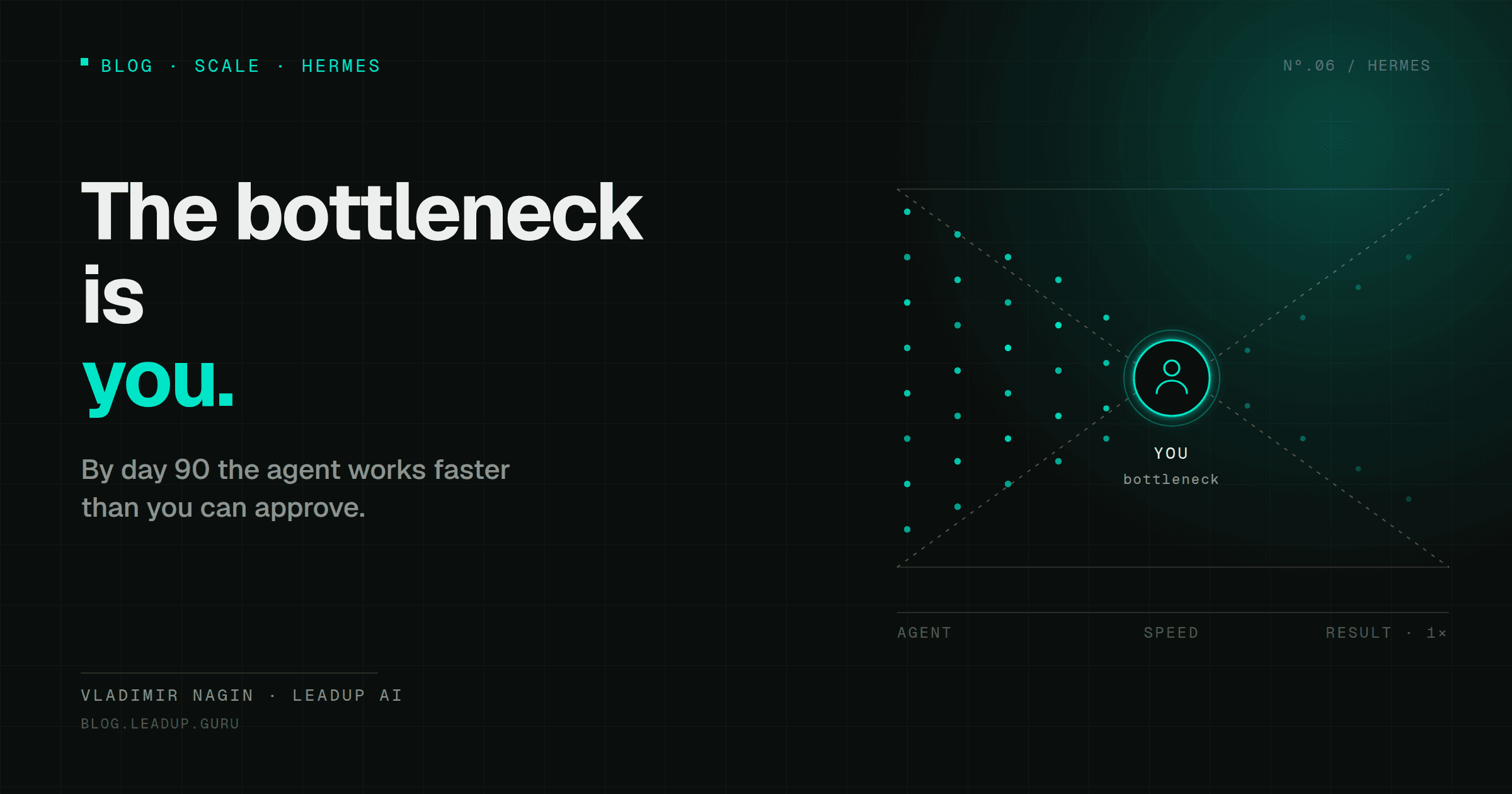

There's a moment that changes your relationship with Hermes forever.
You notice that tasks are piling up in the queue. The agent is ready to take the next step — and waits. Another step is ready — and waits again. The queue grows.
The bottleneck is no longer the agent or the technology.
The bottleneck is you.
This isn't a mistake. This is a signal that the system has started working. And this moment is the turning point in understanding what it means to have an autonomous AI deputy.
The autonomy paradox: why you become the bottleneck
Most people think of an AI assistant as a tool that "slows down" due to technical limitations. But when Hermes reaches full operating mode, the opposite happens.
"The bottleneck is no longer your agents, but you. If your agents are doing work 24/7, and tasks are hanging on them that you're supposed to close — demand from them will keep piling up." — Vladimir Nagin, Hermes intensive, 22.05.2026
What this means in practice.
In confirmation mode (Step 2, days 8–21) the agent writes a draft letter — and waits for your "ok." Prepares a meeting brief — waits. Finds three tasks for delegation — waits. It works fast. You work at your own pace.
This is normal and correct for the calibration period.
But by day 21, when the agent knows your context and you accept 70–75% of its suggestions without correction — keeping it in confirmation mode for all tasks becomes inefficient. You're slowing it down, not the other way around.
The solution: Step 3. Autonomous mode for routine tasks, confirmation only for exceptions.
What day 90 looks like: three live demos
At the closed intensive I showed three Hermes operating scenarios — in real time, without prepared templates, based on real data from participants. Here's what happened.
Demo 1: A full workday assistant in 15 minutes
I load a participant's soul config (productivity assistant) into a fresh Hermes. I say: "Use this config."
Hermes parses the config, understands the role, connects to Google Sheets.
In the next 15 minutes the agent:
- creates a table with 13 columns (task, category, priority, urgency, energy level, deadline, dependencies, delegate);
- fills it with 10 real work tasks with plausible parameters;
- adds a "History" tab (energy level for the day, planned vs actual, reschedulings and reasons);
- conducts a morning briefing: "Good morning. How's the energy? Top 3 tasks for today: ... Quick tasks under 15 min: ... Can be delegated: ...";
- receives a voice message "from a client" with two new tasks — detects a deadline conflict, warns of overload;
- switches to minimal day mode ("No energy, 3–4 hours max") — rebuilds the plan, reschedules tasks with new dates, for each suggests a small first step;
- does an evening check-in: "Done: 2 tasks. Rescheduled: 3. Critical signal: knowledge base — 4 reschedulings, needs decomposition. Time leak: email processing — low importance."
Without touching any code. Without programming. Just the soul config and access permissions.
"The more context the agent has about you and your business, the better it navigates. Without context — generic. With context — targeted." — Vladimir Nagin, Hermes intensive, 22.05.2026
Demo 2: Presentation + speech with fact-checking in 3 minutes
I say by voice: "Create a voice agent presentation for HR onboarding."
Hermes clarifies — for which department? A participant from the chat selects HR.
Three minutes later: 8 slides in a dark industrial style — structure, headings, bullet points. Hermes along the way ran into a technical error on the fourth slide (Cyrillic in an object) — noted it as a skill so it wouldn't repeat.
I ask to add a speech with current data. Hermes goes to the internet, searches for fresh statistics on AI in recruiting, inserts it into the text with links to sources, divides the speech into timecodes per slide. Result — a 9-minute speech tied to each slide.
For comparison: an intern with this task would have spent half a day and come back with numbers without sources.
"About figures you can always ask: 'Where did you get that?' Or 'Fact-check all the figures in this document' — and it fetches the data, verifies." — Vladimir Nagin, Hermes intensive, 22.05.2026
Demo 3: Marketing analytics of 289 rows + CRM task
I give Hermes a file with marketing data — 289 rows, several channels.
A few minutes later a report in Telegram:
- two clear leaders by ROI, one underperformer;
- social media — first place by revenue and ROI;
- referral channel — best lead generator at low cost;
- seasonal traffic dip in summer months with stable conversion;
- concrete recommendations: reallocate budget between channels with reasoning.
I ask to open the CRM and create a task. Hermes connects to HubSpot, finds the needed contact, creates a task with a title, priority, and contact link — sends a link to the created task.
Full cycle from a data file to a CRM task — without switching tabs, without exporting to Excel, without manual entry into the system.
The channel where we break down real AI deployments
Cases, guides and new models — short and to the point.
What to do when the agent works faster than you
When you notice the confirmation queue piling up — that's a signal for three actions.
1. Move routine tasks to autonomous mode
Make a list: which of the agent's actions have you approved over the past two weeks without a single correction? Those tasks go to autonomous mode. You confirm only exceptions — non-standard situations and important decisions.
2. Set a reasonable heartbeat interval
The heartbeat is the agent's "heartbeat": how often it wakes up, checks incoming, and acts. Every launch consumes tokens. Too frequent a heartbeat piles up the queue faster than you can confirm. For most tasks — an interval of 1–3 hours, not every 5 minutes.
3. Give the agent a Telegram account
When the agent works as a full-fledged team member — it communicates under its own name. A separate Telegram account for the agent lets it write to you and team members directly: "Hey, I have an urgent task — come confirm it." This removes confusion and makes interacting with the agent feel like a real employee.
How Hermes grows from one CEO to a team
The standard Step 3 progression — four phases.
Phase 1 (week 4–6): autonomous routine
The agent independently: sends follow-up letters, sets reminders, closes standard requests. You confirm: non-standard decisions, communications with key clients.
Phase 2 (week 5–8): new functions
You add 1–2 new tasks: competitor monitoring, KPI dashboard, integration with corporate systems. Each new function — through Step 1 (observation) and Step 2 (confirmation) again, even if the agent is already autonomous in other tasks.
Phase 3 (week 6–10): agent in the team
Hermes joins the team Telegram group. Takes tasks from employees, distributes them, tracks statuses. Escalates only exceptions to you. This is the transition from "personal assistant" to "executive deputy."
Phase 4 (week 10–13): auto-reporting
A weekly automatic report on the whole business: completed tasks, open risks, metrics, recommendations. Sunday evening the agent generates the report — Monday morning you log in prepared.
"The final signal — when your mornings without your agent start feeling strange. That's the point of no return." — Vladimir Nagin, Hermes intensive, 22.05.2026
What happens after Hermes
Hermes is the first autonomous employee.
When one deputy agent works stably, a logical next step appears: not to replace one employee, but to build a team. Marketer, analyst, sales department assistant, operations manager — each with their own specialization, their own context, their own tools.
For this level there's a separate platform — Paperclip, which orchestrates a team of agents: distributes tasks between them, tracks execution, manages dependencies. Hermes — the first step. Paperclip — the next level.
"From an AI agent you can move to an AI company. When you no longer have just one agent, but a company of many employees, each of whom does something." — Vladimir Nagin, Hermes intensive, 22.05.2026
What's next
When the agent works faster than you — that's not a problem. That's the result.
The bottleneck has shifted to where it belongs: to the decisions that require your judgment, not to the routine tasks the agent closes better and faster.
That's autonomy. Not technological, but managerial.
Vladimir Nagin — founder of LeadUp AI, AI automation practitioner, author of the Neuromasterskaya 2.0 program. Designs and deploys AI agents for executives and teams since 2023.