
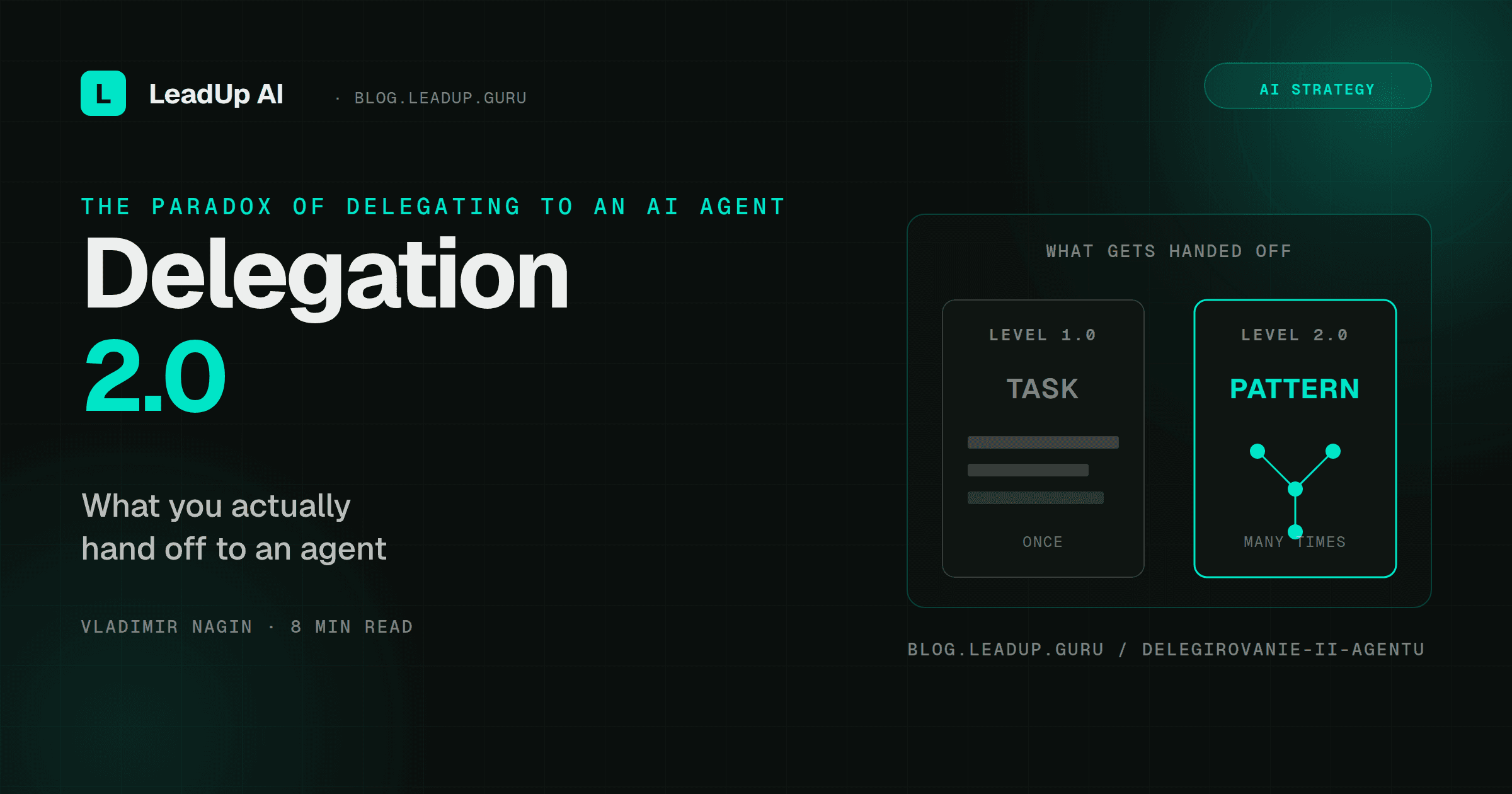

Most executives think of delegation as distributing tasks.
Someone gets a report. Someone gets a client call. Someone gets materials to prepare for a meeting. Delegation is when you hand work to someone who can handle it. Logical. Clear. And almost entirely wrong — when it comes to new-class AI agents.
Because when you delegate a task to Hermes Agent, you're not transferring a task. You're transferring context. A pattern. A decision-making style.
And that's exactly what changes everything.
Short version: Delegating to an AI agent is not transferring a task, but transferring context, decision pattern, and management style. This is exactly what distinguishes Hermes Agent from regular automation: the agent doesn't execute an instruction — it learns your logic.
What delegation really means
Delegation 2.0 is transferring not a task, but a decision pattern: the context of your business, the logic of priorities, and management style to an AI agent that learns to act on your behalf.
When you hire a new deputy, the first two to three months they make no decisions. They observe. See how you react to letters. How you conduct negotiations. Who you call first when something goes wrong, and who — when everything goes well. They absorb not tasks — they absorb the logic of your work.
And only when they've understood that logic does delegation become real. You no longer explain every step. You say "handle it" — and they handle it the way you would have. Or close enough.
That's genuine delegation. Not transferring a task — transferring the context that allows someone else to act on your behalf.
That's exactly how Hermes Agent works. Except the learning cycle is not three months, but two to three weeks.
"After two to three weeks it will start matching your decision in 80% of cases... it understands who you trust, which risks you ignore."
How delegating to an agent differs from delegating to an employee
Here there's one fundamental difference that most people don't notice right away.
When you delegate a task to an employee — you delegate once. They executed it, reported, done. Next time you'll have to explain the context again or rely on their memory again.
Hermes Agent works as an autonomous AI agent and AI deputy CEO: it saves each interaction as a skill. After each completed task it analyzes what worked and what didn't. Updates its internal knowledge base about how you work. And next time uses this accumulated context without additional explanations on your part.
This is a fundamentally different model. Not "hand it over — forget it — explain again." But "hand it over — it remembered — next time no need to explain."
As it was put at one recent intensive: "I delegated that task to it, it completed it and returned it to me." But the same way — next time. And the day after. And in a month.
Moreover, an employee who accumulates such context usually becomes irreplaceable. An agent — available at all times.
What exactly you transfer to an AI agent: three context layers
If you break down delegating to an AI agent into components, you get three layers.
The first layer — context of your business. Who your key partners are, how processes are structured, which tools are used, what is critical and what is secondary. This context the agent receives from connected sources: email, CRM, calendar, correspondences.
The second layer — your decision pattern. How you respond to different types of letters. Who you reply to immediately, who — the next day. What tone you maintain with partners, what — with the team. How you prioritize when everything is urgent. This pattern the agent reads from your actions — every one of your responses, every approved draft letter becomes a self-learning signal.
"Every one of your responses is some kind of self-learning signal for it."
The third layer — your style. Not just what you decide, but how. Are you inclined toward quick decisions or do you weigh for a long time? Do you trust intuition or require numbers? Do you keep doors open or filter access? This style the agent copies — at first coarsely, then more precisely.
"The agent adjusts to you itself, it copies your style, understands how you act."
These are the three things you're actually transferring. Not "a task." Part of your management identity — in a form that can work without you.
The channel where we break down real AI deployments
Cases, guides and new models — short and to the point.
The line of the non-delegable: what you can't delegate to an AI agent
Now — the most important thing. What can't be delegated.
A significant part of an executive's decisions are routine. This is a fact that everyone agrees with who honestly looks at their working week. "Forty percent of an executive's decisions — they're essentially routine... anyone could in principle make them if they had the context of your company."
If someone has the context — they can make those decisions instead of you. And an agent with the accumulated context of your business handles this well.
But there are decisions of a different kind.
That meeting where you need to feel that the partner is not saying everything — and restructure the conversation on the fly. That moment when you need to tell the team something they don't want to hear — and find words that don't destroy trust. That situation when you need to break the rule you set yourself — because the context has changed.
This is yours. Not transferred. Not automated. Not saved in the agent's knowledge base.
And this isn't a weakness of the system. This is its essence.
"The key principle: you decide when to switch to the next mode... Hermes won't take control from you — you'll gradually expand it."
The line between what can be delegated to the agent and what remains only with you — that's the line of your professional value. Everything on one side — reproducible, routine, can be expressed as a pattern. Everything on the other — requires presence, judgment, human context that the agent doesn't have.
Knowing this line isn't an abstraction. It's a practical tool. Because it exactly shows what is worth spending your time on — and what isn't.
How this changes your approach to work right now
Here's the paradox that only reveals itself after you start working seriously with an AI agent.
Delegation isn't about "freeing up time." It's about "understanding what in your work is reproducible and what is unique."
While you're doing everything yourself, you have no ability to distinguish this. The routine and the non-routine are mixed together. Routine and strategy merge into one flow of tasks that need to be done today.
When an agent appears — and you start explaining to it what and how to do — you're forced for the first time to formulate a pattern. "Such letters I read immediately. Such ones — at the end of the day. To this type of request I always respond this way."
This formulation is already a value in itself. You finally understand how you actually work. Not how you think you work — but how you actually work.
"Like when you hired a deputy, and the first month, second, third month they sit next to you... you gradually hand work over, watch, evaluate." With the agent this process is faster. And it forces you to think about your work as a system — not as a flow of situations to react to.
What to do as a first step
Take one repetitive action from your week. Not the most important one. Not all email — but, for example, responses to partner requests on a specific type of question. Or preparation for a weekly team call.
Describe to the agent how you do it. Not an instruction — but the logic. What you look at first. What matters to you. What result you consider good.
Give it two weeks. Watch it adapt.
And then answer yourself: which of what you explained is about you? And which is just routine that anyone could handle who has the needed context?
The line between these two answers — that's exactly what Delegation 2.0 helps you see.
Read about what the executive's role looks like when operations are delegated — in the article Who the CEO Becomes in the Age of AI Agents. About the practical ROI calculation of an AI assistant — in How Much Is an Hour of Your Time.
Vladimir Nagin — founder of LeadUp AI, AI automation practitioner, author of the Neuromasterskaya 2.0 program. Designs and deploys AI agents for executives and teams since 2023.