

Imagine such a morning.
You open email — it's already all sorted. Priorities are set. Urgent items highlighted. Three key letters have ready draft replies. At 9:30 a meeting with a partner, and 30 minutes before it a briefing arrived in Telegram: history of the relationship, negotiation status, where the risk is, what they might bring up.
You look at this and think: "Everything is under control."
And then a different thought arises. Slow. Slightly anxious.
"And what do I do now?"
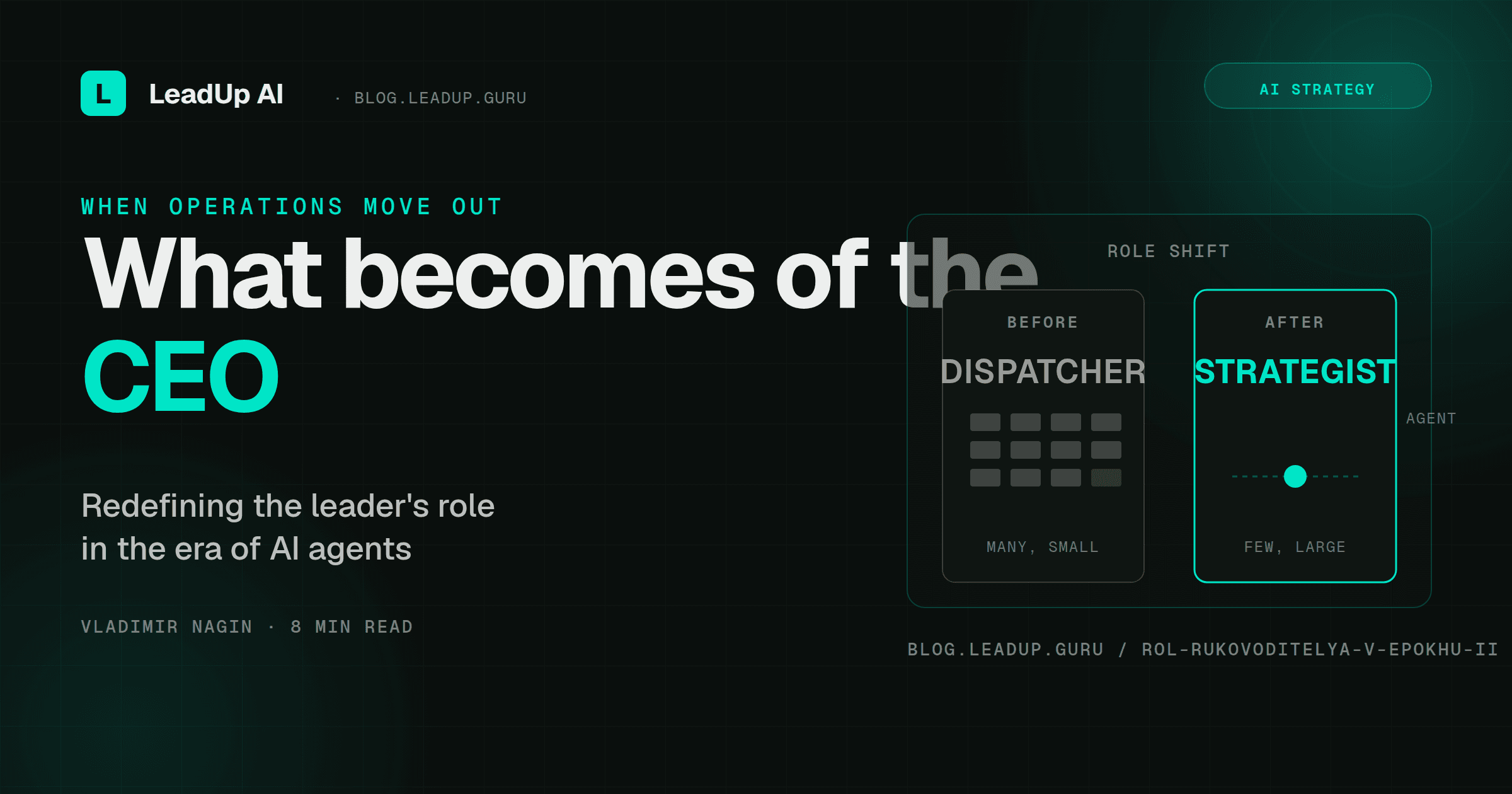
Short version: When an AI agent takes on most of the operational load, the executive doesn't "free up time" — they change their role: from dispatcher to strategist. The question "what am I for then" is honest — and has an honest answer.
Most of your time you're working where your value isn't maximum
Ask any executive why they got into their profession. Almost nobody answers: "to sort through email," "to set deadlines on routine tasks," "to prepare weekly reports."
People go into management for something else. For vision. For the ability to build — a team, a product, a market. For decisions that actually change things.
But a real working week looks different.
"Most of executives' time is operations, not strategy," says Vladimir Nagin. For what you created the business for — strategy, relationships with key clients, choosing direction — "between ten and fifteen hours remain."
One to two days a week for what matters. The rest — dispatching.
This isn't personal weakness. This is a structural trap that most executives fall into as the business grows. The bigger the team, the more requests. The more complex the processes, the more points that need your attention. And now you're no longer a strategist. You're a bottleneck.
A digital deputy is an AI agent trained on the decision patterns of a specific executive, which takes on operational functions: email analysis, KPI monitoring, meeting briefing preparation, and routine communications.
What happens when an AI agent takes on operations
The standard conversation about AI agents sounds like: "It will free up time for you." And that's true — but it's not the main truth.
Because "free up time" is about quantity. And the real question is about quality. Not how many hours you get back, but what you do with them.
When the agent takes on incoming email analysis, KPI monitoring, meeting preparation, routine team correspondence — you don't just get free time. You get the opportunity to once again be who you wanted to be when you started.
"Hermes gives you back ten to fifteen hours per week for what you created the business for."
This isn't a metaphor. This is a literal redistribution: what previously required your presence — meeting briefings, email sorting, execution monitoring — now arrives to you already in finished form. And what requires your judgment — remains with you.
Who the executive was "before": a dispatcher pretending to be a strategist
There's one thing executives rarely admit out loud.
Most of the decisions they make every day — aren't unique. They're routine. Repeating. The same patterns, in slightly different context. The same answer to the same category of questions — again and again.
"Forty percent of an executive's decisions — they're essentially routine... anyone could in principle make them if they had the context of your company."
This doesn't mean the executive is doing poor work. It means a significant portion of working time is spent on decisions that by their nature are reproducible. On questions where the answer is determined not by personal judgment, but by context — who, what, when, what priority.
And alongside these routine decisions — in a flow of requests, notifications, "sign this," "take a look at that" — somewhere the decisions get lost that are truly unique. The ones where exactly your view is needed. Your understanding. Your experience that can't be digitized.
"Routine kills our creativity and energy." This isn't rhetoric. This is a mechanism: when you switch from task to task, question to question, context to context all day — by evening you simply have no resource left for what requires depth.
The executive "before" is a person with enormous potential, most of which they spend on functions that could be delegated. Only before there was nobody to delegate to.
The channel where we break down real AI deployments
Cases, guides and new models — short and to the point.
Who the executive becomes "after": a strategist who's finally allowed to do strategy
This isn't just a pretty phrase.
When the agent takes on routine decisions, communications, and monitoring, several things happen to the executive simultaneously.
First: the head gets unloaded. There's a difference between "I have 90 free minutes" and "I have 90 minutes while I'm not thinking about email and deadlines." The second is a different state. Strategic work is only possible in it.
Second: the quality of presence at important meetings changes. When you arrived at negotiations with a briefing — relationship history, status, risks — you don't spend the first 15 minutes restoring context. You arrive prepared. And the conversation goes differently.
"30 minutes before each meeting a briefing arrives in Telegram — relationship history, status, risks" — this is from a real case of a marketing agency head who described the change: "Didn't realize I had an assistant — until Wednesday morning when I opened email and saw a ready digest already with priorities."
Third: the relationship with control changes. Paradoxically, when the agent monitors metrics and escalates anomalies — the executive doesn't lose control. They change it. Instead of reactive "someone said something's wrong" — proactive "the agent noticed a deviation and came with three hypotheses."
This is a fundamentally different role. Not "I check everything myself," but "I know that if something important changes — I'll be informed."
"The key principle: you decide when to switch to the next mode... Hermes won't take control from you — you'll gradually expand it."
What to do with the anxiety of "what am I for then"
There's one question that comes up for almost every executive when they seriously think about AI agents for the first time. It rarely gets voiced. But it's there.
"If the agent does what I used to do — what am I for then?"
This isn't weakness. This is an honest question about professional identity. And it deserves an honest answer.
The answer is this: the agent does what is reproducible. But your work as an executive isn't only reproducible actions. It's also something else.
Vision that isn't in any database. Trust that's built over years in live communication. Decisions under incomplete information, where context isn't digitized and never will be. The ability to say something difficult to the team — in a way that doesn't destroy the relationship, but strengthens it.
All of this remains. And becomes more visible — exactly because everything else has finally stopped drowning it out.
The executive "after" isn't someone who got a helper for routine. This is a person who finally got the opportunity to work at the level they were created for.
One question and one step
Here's a question worth asking yourself right now:
What are you spending time on that you'd like to spend differently?
Not "what do you dislike doing." But what you do regularly — while knowing this isn't where your value is maximum.
That's the first task for the agent.
Not "automate everything." Not "implement a system." Simply — take one specific function that takes up a significant portion of your time and recurs regularly. Explain to the agent how you do it. Watch for a week.
Because the first thing you'll get isn't freed-up time. It's clarity. Understanding what in your work was dispatching, and what was truly yours.
And that understanding changes everything.
Read about what exactly you hand over to the agent when delegating — in Delegation 2.0.
Vladimir Nagin — founder of LeadUp AI, AI automation practitioner, author of the Neuromasterskaya 2.0 program. Designs and deploys AI agents for executives and teams since 2023.