

Key takeaways in 30 seconds:
- One "super-agent" is worse than five specialized ones: the broader the agent's context, the weaker the result on each task.
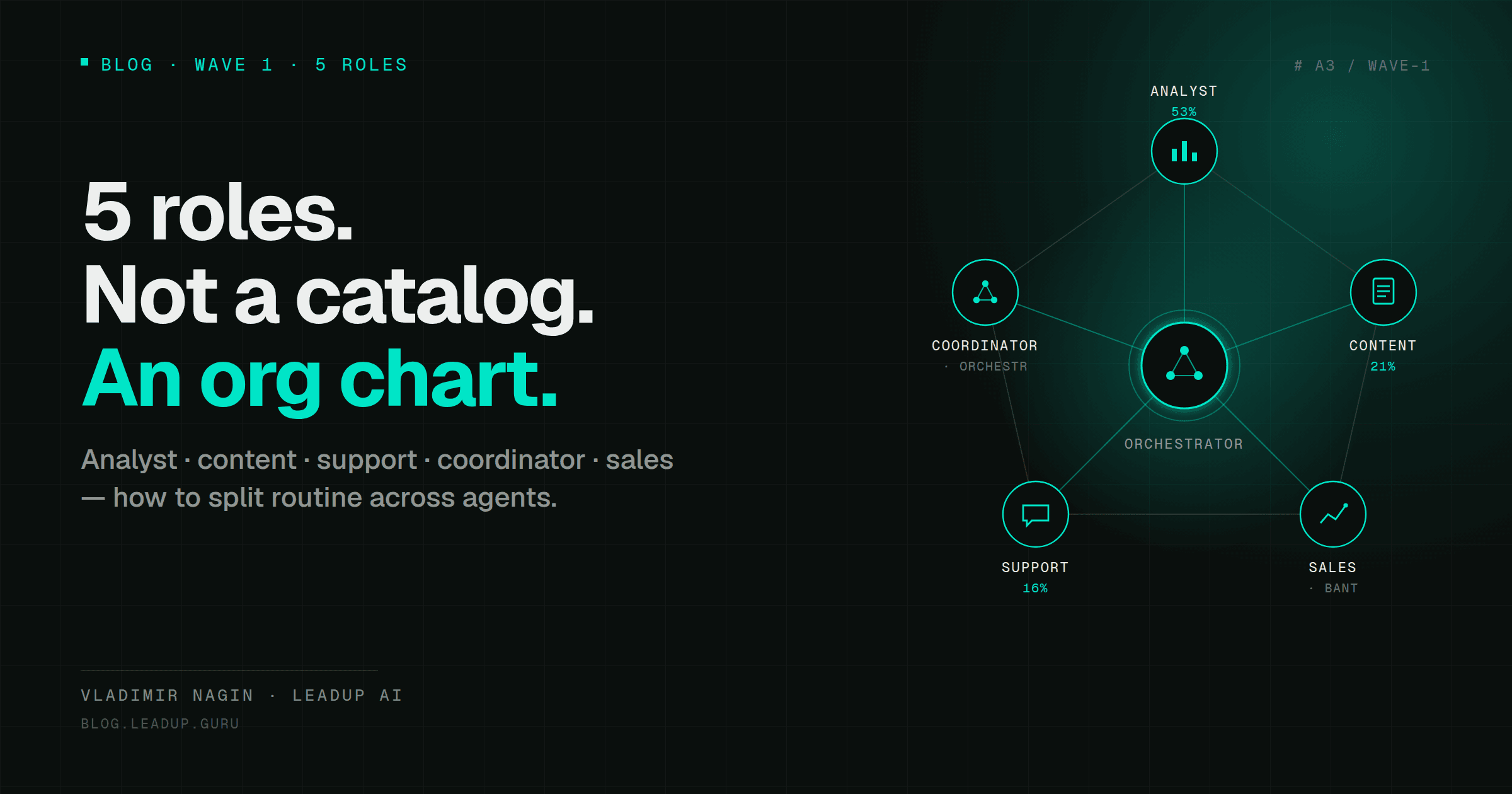
- 5 AI team roles — this isn't a tool catalog, it's an org chart: analyst (53% of the load), content (21%), support (16%), coordinator, sales.
- Real case: Alexander (network business, 100 partners) built 5 agents in one evening — "a benchmark of decomposition."
Alexander runs a network business (~100 partners). Every day — dozens of questions about company products, onboarding newcomers, creating content for social media, lead magnets for recruiting.
He drew a scheme of 5 agents and sent it as homework before our intensive.
When I saw this scheme — I said: "This is a benchmark of decomposition. This is what an AI team should look like."
What exactly did Alexander do right — and how to replicate it in your business?
Most entrepreneurs who start with AI make one mistake: they look for a "super-agent." One prompt that can do everything. One ChatGPT you can ask any question — and get everything you need.
This is a trap. Not because AI can't handle it. But because contexts will mix — and quality will drop to the "average".
Alexander did the opposite. And his scheme worked exactly because of that.
Why one agent isn't a company
One AI agent can't simultaneously be a marketer, analyst, support specialist, and sales rep. Technically — it can. In terms of quality — no.
Imagine an employee assigned tasks from five different managers simultaneously, without explained priorities. They'll do everything mediocrely.
With an agent — the same story. The broader the context, the weaker the result on each specific task.
The right approach: one role — one task — one agent. When each agent is specialized, it works more accurately, faster, and more predictably.
More on the architectural choice — in the article AI First — It's About Company Design.
Role 1 — AI Analyst: closes 53% of the pain
The most frequently cited task that entrepreneurs name at our events — manual data processing. That's 53% of voters at the April 2026 intensive.
What the AI Analyst does:
- Collects data from CRM, messengers, spreadsheets
- Generates weekly and monthly reports
- Analyzes dynamics: what grew, what fell, why
- Maintains client cards in CRM — precisely per instructions, without gaps
Typical trigger: "New application came in → agent created a card in HubSpot, added tags, wrote an initial client potential analysis by BANT methodology (budget, authority, need, timing)."
Business result: data stops getting lost. Reports appear without reminders.
Role 2 — AI Content Producer: 21% of your time back
The second most-voted result of the survey — content creation. 21% of entrepreneurs named this their biggest time drain.
What the AI Content Producer does:
- Writes posts for Telegram channel, Instagram, LinkedIn in brand voice
- Adapts one piece of content to several formats
- Generates topics based on trends and audience requests
- Creates scripts for video
Important nuance: the agent doesn't replace the author's voice — it works with it. Give it examples of your best posts, and it will reproduce the style.
Typical trigger: "Every Monday at 10:00 → agent receives a list of topics → forms a plan for the week → by 12:00 three ready posts for approval."
Role 3 — AI Support: answers without "one moment, let me check"
16% of intensive participants named answering repetitive requests as their main pain. If you have clients — you know what this is about.
What AI Support does:
- Answers frequently asked questions in Telegram, WhatsApp, by email
- Qualifies incoming requests: urgent/non-urgent, simple/complex
- Passes non-standard cases to a human with already-prepared context
Critical point: for sensitive topics (medicine, law, finance) a human always needs to be in the loop. The agent prepares the answer — a human approves it. This is the correct architecture: the automated system handles routine, the human controls the sensitive.
What this gives: the client gets an answer within a minute. Always. At 3 AM, on Sunday, on holidays.
The channel where we break down real AI deployments
Cases, guides and new models — short and to the point.
Role 4 — AI Coordinator: the one who launches everyone else
This is a special role — orchestrator. It doesn't execute tasks itself. It receives incoming requests, distributes tasks among other agents, and monitors execution.
What the AI Coordinator does:
- Receives a new request (lead, application, letter, message)
- Determines: who should take the task
- Passes the task with context to the right agent
- Collects results and forms a summary for the CEO
Why this matters: without a coordinator, agents are separate specialists who don't know about each other. The coordinator turns them into a team.
Automation without coordination is not a system. It's just a set of AI employees who don't know about each other.
Role 5 — AI Sales Rep: the first touch that never gets tired
5% of intensive participants named lead generation and sales as their main pain. But in fact this role matters for any business that works with inbound applications.
What the AI Sales Rep does:
- Qualifies leads by BANT (budget, authority, need, timing)
- Conducts initial dialogue and collects information about the client's task
- Passes a "warm" lead to a live manager with a ready dossier
- Makes a repeat touch 24 hours after the first contact
Why this changes the funnel: conversion from first touch to qualified lead grows when the agent responds instantly and doesn't "forget" to get back to the client the next day.
Alexander's case: 5 tasks → 5 agents → a working system
Back to Alexander.
He has ~100 partners in the network. Each partner — a source of questions, tasks, content requests.
What he did:
| Task | Agent |
|---|---|
| Answers to questions about company products | AI Product Expert |
| Onboarding newcomers (0–30 days) | AI Newcomer Coach |
| Recruiting into the network | AI Recruiter |
| Creating TG/social content | AI Content Producer |
| Lead magnets and PDF materials | AI Lead Magnet Designer |
Each agent has:
- A clear role (no overlaps)
- An explicit trigger (what launches it)
- A specific data source (product knowledge base, partner history)
"One task — one agent, no overlaps. A benchmark of decomposition."
This isn't just a pretty diagram. This is a working operating system for the business.
How to compose your own 5 roles
You don't need to copy Alexander's scheme. You need to apply the same principle to your own situation.
Take the survey results as a starting point: analytics (53%), content (21%), support (16%), coordination (5%), sales (5%) — these are the five universal roles for most small and medium businesses.
Your next step:
- Write down 3–5 tasks that repeat more than 3 times a week
- Assign one agent role to each task
- Make sure the roles don't overlap
- Start with one agent — the most frequent and simplest one
Don't try to automate everything at once. Find one or two routine processes, run a pilot, make sure it works — and then add the next one.
Conclusion: the AI team org chart is a strategic choice
5 AI employee roles — this isn't a list of tools.
This is the org chart of your future operational team.
When you look at these roles — analyst, content, support, coordinator, sales — and relate them to your business, you're not making a technical choice. You're making a strategic choice: which functions in your company should run on algorithms, not on people.
Vladimir Nagin — founder of LeadUp AI, AI automation practitioner, author of the Neuromasterskaya 2.0 program. Designs and deploys AI agents for executives and teams since 2023.