

Key takeaways in 30 seconds:
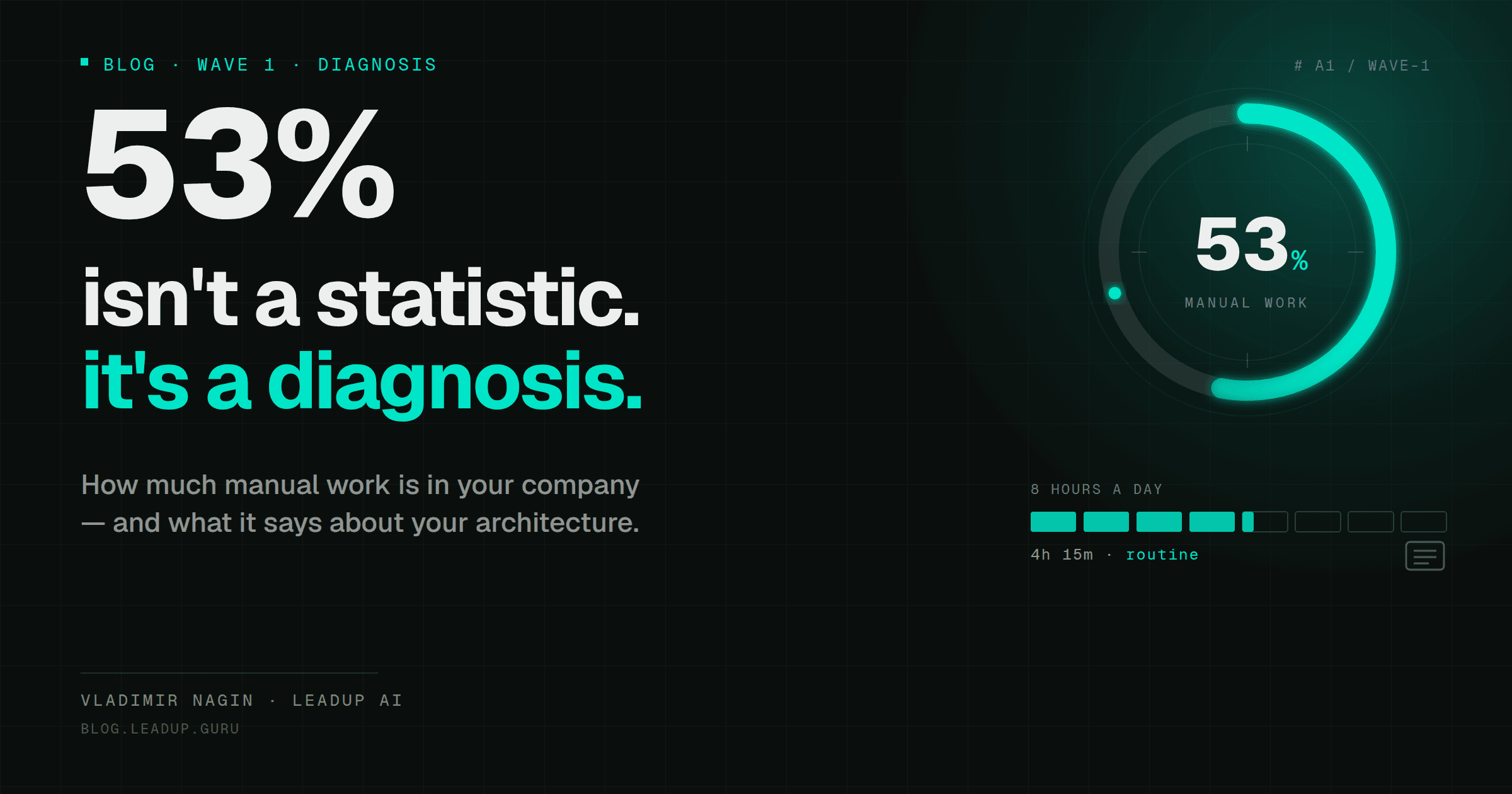
- 53% of entrepreneurs spend more than half their working time on manual tasks — that's more than 1,000 hours a year.
- An AI tool without an AI architecture is an upgrade, not a transformation. "Adding ChatGPT" and "becoming an AI company" are different things.
- The cost of AI computing fell 280 times in 2 years (Stanford HAI 2025): launching an agent for a month costs less than one employee work shift.
I asked one question to 28 entrepreneurs in a live broadcast.
One question: "Which task eats the most of your time?"
53% pressed one button. One. "Manual data processing."
I looked at that result and thought: this isn't statistics. This is a diagnosis.
If more than half of your working time goes to something that can be described as "I sit and manually move things around" — your company isn't growing. It's servicing its own processes.
This isn't your fault. It was the only way to run a business — until recently.
But now everything has changed. And exactly now it's important to understand: what does this number — 53% — actually say about your company.
What happens to a business when 53% goes to manual work
Let's do the math.
A workday is 8 hours. 53% — that's 4 hours and 15 minutes. Every day. On data entry, report generation, answering repetitive questions, manually maintaining the CRM, coordinating tasks through messengers.
Multiply by 250 working days a year. You get more than 1,000 hours. That's a month and a half of pure working time — on work that can be automated.
But it's not just time.
Manual processing also means errors. Lost letters. Forgotten tasks. Data that "was somewhere." A CRM that "nobody properly maintains." This isn't a problem with people. This is an architecture problem.
When your growth depends on how fast a person moves data from one spreadsheet to another — you're building a company on the most unreliable foundation: human attentiveness in routine labor.
Three symptoms of a "manual" company
You'll recognize your company if at least one of these applies to you:
Symptom 1. You are the biggest bottleneck. Everything waits for your decision, your correction, your approval. Tasks get stuck not because employees are bad — but because there's no system that knows on its own what to do next.
Symptom 2. Your data doesn't work for you. You have data — in the CRM, in spreadsheets, in correspondences. But to get an answer to the question "what's happening in the business," you have to sit down and manually compile something for an hour. The data exists. The insights don't.
Symptom 3. Routine kills your creative potential. You started a business to create something new. But you spend the day figuring out order statuses, updating a spreadsheet, and forwarding a file. That's not what companies are founded for.
The channel where we break down real AI deployments
Cases, guides and new models — short and to the point.
Why "I use ChatGPT" doesn't solve the problem
Many entrepreneurs I meet have already tried AI.
They use ChatGPT for writing texts. Connected Notion AI for notes. Tried Make for automating a couple of processes.
But 53% of time still goes to manual work.
Why?
Because they added AI tools to the old company architecture. This is like putting a microwave in a kitchen that still runs on firewood. The microwave exists. But the main process hasn't changed.
An AI tool without an AI architecture is an upgrade. It's not a transformation.
For real change you need to redesign who makes the routine decisions in your company. Not "add" AI — but put it at the center of the operational process.
This is exactly what distinguishes an AI-enabled company from an AI-First company — the topic of the next article.
Economics that nobody talks about
The most common argument against AI automation: "too expensive" and "too complicated."
Both are no longer true.
The cost of computing fell 280 times in two years — that's data from the Stanford HAI AI Index Report 2025. In 2023 a million processing tokens cost $20. Now — $0.07. Hardware is getting cheaper by 30% every year.
The practical conclusion is direct: launching an AI agent for a month costs less than one employee work shift.
One agent that closes 4 hours of daily manual processing — costs less than one person-day of someone who used to do the same thing.
This isn't a hypothesis. This is the current market reality.
First step: a 15-minute diagnostic
Before automating — you need to understand what exactly to automate.
At the intensive we gave participants a four-step homework assignment that takes 15–20 minutes and gives a complete picture:
- Step 1. Write down 3–5 tasks that you or your team do manually more than 3 times a week.
- Step 2. For each task, assign an AI employee role (who could do this instead of you: analyst, content manager, support specialist?). Full breakdown — in the "5 Roles of AI Employees" article.
- Step 3. Draw an org chart: who reports to whom in this future team.
- Step 4. Write down the tools each agent needs (CRM, messenger, database, calendar).
In 15 minutes you'll see not abstract "AI automation," but a concrete map of your future AI team.
Bottom line: the 53% number is an architecture indicator
The 53% number isn't an unpleasant statistic you can ignore.
It's an indicator of your business architecture.
A company that runs on manual labor where it could run on algorithms — isn't losing to competitors today. It's losing to them in a year. When their algorithms do in 10 minutes what takes you a full workday.
Everything is fine with you. You're just building a 2023 company — in 2026.
Vladimir Nagin — founder of LeadUp AI, AI automation practitioner, author of the Neuromasterskaya 2.0 program. Designs and deploys AI agents for executives and teams since 2023.