

Key takeaways in 30 seconds:
- Using ChatGPT ≠ being an AI company. Between "AI-enabled" and "AI-First" — a gap like between a flip phone and a smartphone.
- AI First is an architectural decision: the company is designed around agents, not agents added to the company.
- 2026 is a turning point: computing costs fell 280 times, models became agent-ready, visual AI team orchestrators emerged without code.
You use ChatGPT every day. Maybe a few more AI tools as well.
Are you an AI company?
Most entrepreneurs I ask this question answer: "Well, in a sense — yes."
No. And here's why this matters.
In April 2026 we held a two-day intensive on AI companies of the future. Twenty-eight entrepreneurs came on the first day — from different niches, with different experience, but with one thing in common: they all already "used AI."
By the end of the first day it became clear: using AI and being an AI company are different things. So different that it's not evolution between them — it's a paradigm shift.
Understanding this difference means understanding where your business is today and where it needs to go.
Four levels where companies are now
When we talk about AI in business, we're not talking about one phenomenon. These are four fundamentally different maturity levels:
Level 1 — LLM assistant. A smart text generator. You ask questions, it answers. Business analogue: a reference book. Most companies are stuck here — and don't realize it.
Level 2 — AI agent. LLM + tools + memory. One "employee" who can not just answer, but perform actions: write letters, maintain CRM, create documents. Status: advanced users today.
Level 3 — Multi-agent team. Several agents with roles that coordinate and pass tasks to each other. Business analogue: a company department. Status: leading players.
Level 4 — AI company. Orchestrator + org structure + budget + KPIs. A full-fledged company where AI isn't a tool, but the business operating system. Status: a handful of companies.
Question: where are you now? And where do you want to be in 6 months?
What's the fundamental difference between "I use AI" and "AI First"
Imagine two entrepreneurs.
The first opens ChatGPT when they need to write a text. Sometimes uses Notion AI for notes. Set up automation in Make for a couple of processes.
The second did the following: redesigned their business processes around agents. The first question with any new task — not "who to hire" but "which agent will do this." Their operational routine runs without their involvement.
The first — AI-enabled. AI added to the company. The second — AI-First. The company is designed around AI.
At first glance — a difference in nuance. In practice — a difference in growth rate, operational costs, and scalability.
AI First is when the company is designed around agents, not agents added to the company.
Vladimir Nagin, CEO of LeadUp AI
The analogy that explains everything
There's a flip phone and there's a smartphone.
Both make calls. But they're built on fundamentally different principles.
A flip phone is a device that has a calling function added to it. A smartphone is an operating system with an app ecosystem, one of which is "Phone."
When you add ChatGPT to an existing company — you get a flip phone with an AI app.
When you redesign the company around AI agents — you get a smartphone that calls, maintains CRM, writes texts, and manages tasks simultaneously.
The difference isn't in features. The difference is in architecture.
The channel where we break down real AI deployments
Cases, guides and new models — short and to the point.
What an AI-First company looks like from the inside
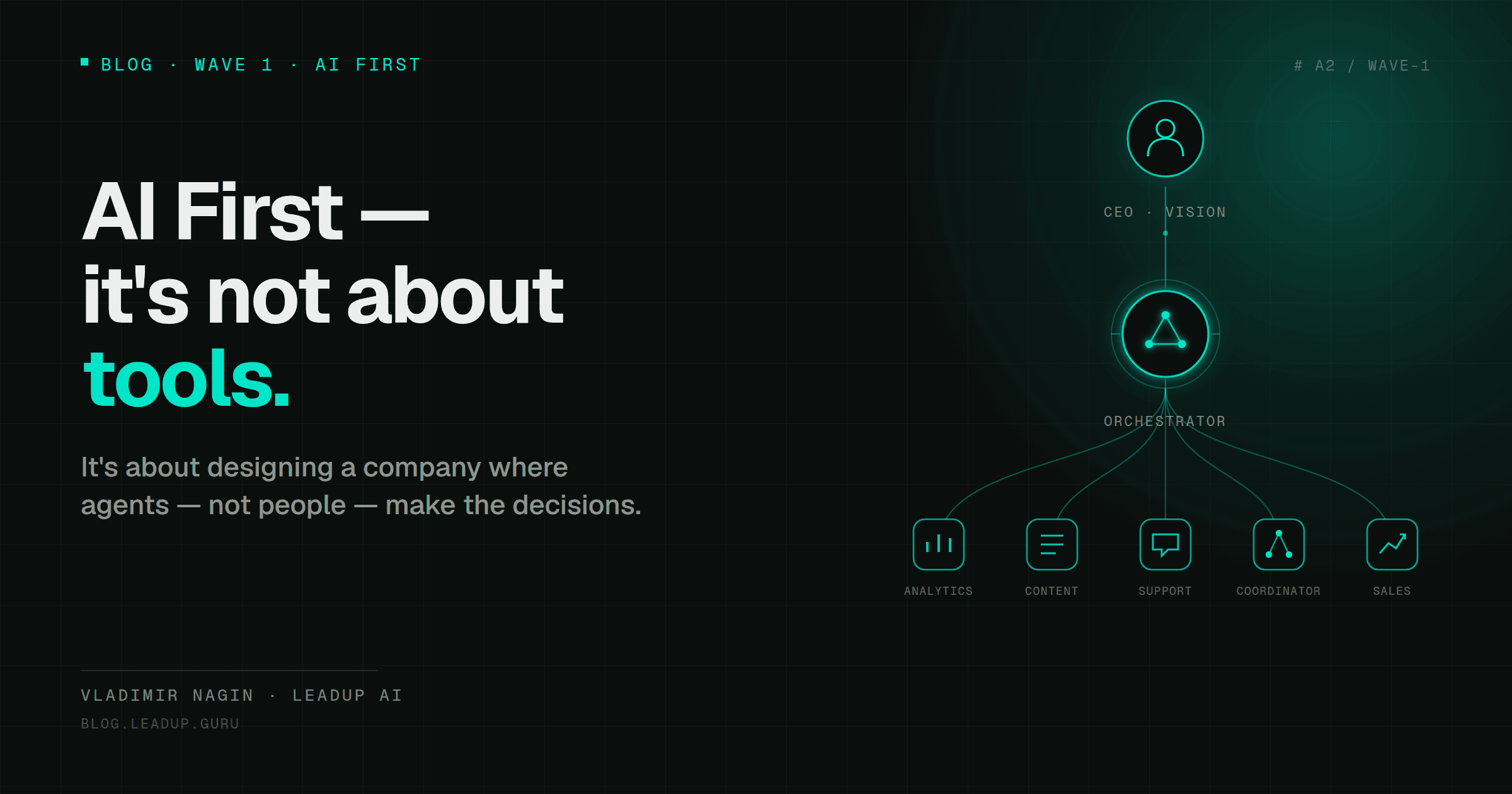
Here's what I demonstrated to intensive participants: a real AI company in Paperclip.
Structure:
- CEO / Founder — strategist and visionary, sets top-level tasks
- CEO agent (orchestrator) — distributes tasks, monitors execution
- 5 directions — marketing, sales, content, analytics, operations
- Under each direction — sub-agents with specific specializations
The key point: this isn't process automation anymore — it's team management.
When I set the task "create content for a new product," I didn't write a single line of text myself. The marketing agent assigned the task to the content agent, who assigned it to the design agent. I received the finished material. My involvement — 2 minutes to set the task.
More on roles and decomposition principles — in the article 5 Roles of AI Employees.
Why 2026 is the turning point
Dario Amodei, CEO of Anthropic, has repeatedly publicly forecast: "70–80% probability that a company with a billion dollars in revenue and one human will appear in 2026."
This isn't science fiction. This is a current trend that's accelerating.
Three things that happened in the past two years and made an AI company possible right now:
- Computing costs fell 280 times (Stanford HAI AI Index Report 2025). Launching an AI agent for a month costs less than one employee work shift. The economics stopped being a barrier.
- Top models became "agent-ready." Claude 4, GPT-4o, Gemini 2.5 natively support tools, memory, and multi-step planning. You don't need to be a developer to build agentic systems.
- Visual AI team orchestrators appeared. Paperclip, Hermes, n8n with AI nodes — tools that let you manage a team of agents through an interface, not through code. A year ago they didn't exist. Now they're in production.
The question is no longer "does my business need this." The question is "will I be ready when this becomes the market standard."
Three first steps toward AI-First
Step 1 — Define who the 'operational machine' is in your company. Write down all the repetitive tasks that you or your team perform. This is the map of future agent roles.
Step 2 — Stop adding AI tools — start assigning agent roles. Not "use ChatGPT for texts," but "assign a Content Agent who receives an assignment and delivers a result."
Step 3 — Start with one agent, not a system. The most common mistake — trying to automate everything at once. Start with one role. Launch it. Make sure it works. Add the next one gradually.
Conclusion: AI First is about who makes decisions
AI First isn't about which tools you use.
It's about who makes the operational decisions in your company.
If it's still you and your employees — you're AI-enabled. The tools are there, the architecture has stayed the same.
If routine decisions are made by agents, and you manage strategy — you're moving toward AI-First.
This difference will be visible in the numbers in two years. Better to understand it now.
Vladimir Nagin — founder of LeadUp AI, AI automation practitioner, author of the Neuromasterskaya 2.0 program. Designs and deploys AI agents for executives and teams since 2023.