

From Vladimir Nagin — founder of LeadUp AI, over three years working with AI agents, trained 500+ entrepreneurs in business automation.
This article is part of the Hermes Agent series. Start from the beginning: How Much Is an Hour of Your Time: AI Assistant for Executives.
Most executives who "already use AI" actually use it the same way: opened ChatGPT, wrote a request, got an answer, closed the tab. This is useful. And it's an outdated level of working with AI.
Not because ChatGPT is bad. But because in 2026 there are two more levels where AI behaves fundamentally differently: it notices anomalies on its own, drafts solutions on its own, runs projects on its own and sends you a report after the fact.
The gap between level 1 and level 3 is exactly the "AI competitive advantage" that the industry has been talking about for the past year and a half. And the main thing about this gap is not the technology. The main thing is how you build trust with the agent. Exactly as you once built it with a new deputy.
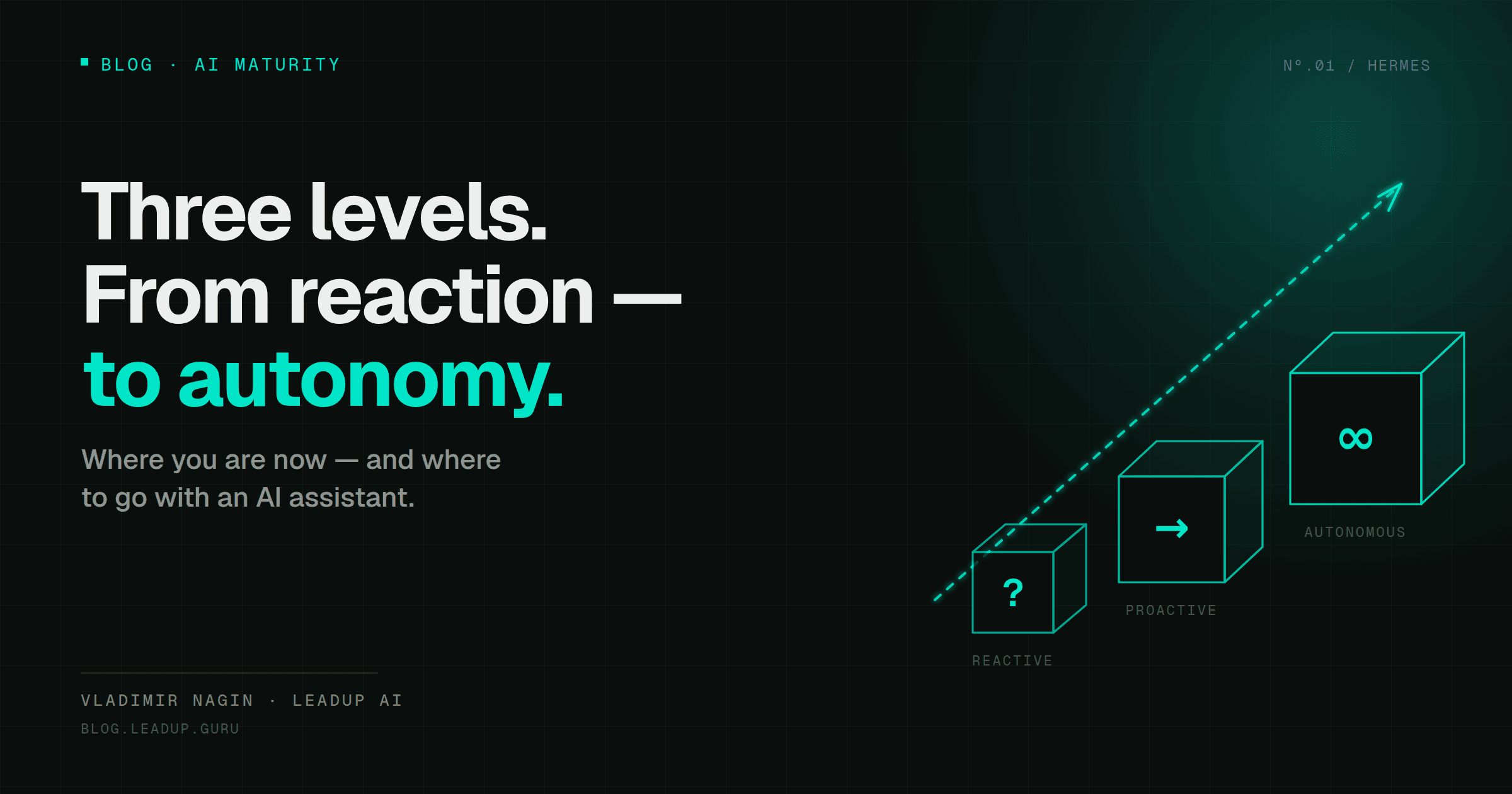
In this article — three levels of maturity, three operating modes, and three steps to move from level 1 to level 2 in the first week.
Level 1: Reactive
This is the level where the majority of AI users are today.
"The first level is reactive. This is the level of the 2024 assistant. That is, when we must ask it a question — we write to it, it replies. This is a reactive way of communicating. As soon as we stop writing — we stop getting information." — Vladimir Nagin
Reactive mode is the mode of an ordinary chatbot. The tool can formulate answers beautifully, but it has zero autonomy. The human is still running the process: you ask — AI answers.
There's nothing wrong with this. Need to translate a presentation to English? ChatGPT handles it perfectly. Need to quickly come up with five headline options? Open Claude or Perplexity. This is a workable level for one-off tasks.
The problem isn't that the reactive level is bad. The problem is that it doesn't scale. Every use requires your involvement. Ten tasks — ten separate sessions. This is simply a more convenient replacement of manual labor, not a structural change in how you work.
"Essentially, 80%+ of AI tool users are at about level 1, reactive." — Vladimir Nagin
This is an empirical estimate from practice. There's no precise public statistics — but if you honestly answer the question "how do I use AI," you'll probably find yourself among this 80%+. That's not a criticism. It's just the starting point.
Level 2: Proactive
At the second level, the mandatory initiation from the human disappears. The agent sees what's happening — and without your request forms the next step.
"The second level is proactive. That is, value appears. Hermes Agent can, for example, notice some anomaly on its own — for example, see that some sales department KPI has deviated. And it presents you with three hypotheses and a draft letter." — Vladimir Nagin
A concrete example. You have a sales department of five managers. The agent sees their KPI daily — it has access to the CRM. On Wednesday morning the agent notices: one manager's conversion dropped by half on Tuesday. Without your request the agent:
- Formulates three hypotheses — what might have happened.
- Prepares a draft letter to the manager: "Sergei, I noticed your conversion dropped yesterday. What happened?"
- Attaches a digest of past communication with the manager — so you understand the context.
You just need to read and decide: send as-is, edit, defer, or ignore. Time spent on this task — three minutes instead of an hour.
The fundamental difference from level 1: the agent acts on your behalf, based on your priorities and business context. Not you writing a request — it sees the situation on its own.
For this to work, the agent must be connected to your data sources: email, calendar, CRM, messengers, analytics systems.
Level 3: Autonomous
At the third level the agent no longer suggests options — it acts. And sends you a report on what it did.
"And autonomous — that's a mode where our agent already runs projects on its own. That is, it will inform you after the fact… For example, client onboarding: sent a welcome letter, scheduled an initial meeting, handed off to the team." — Vladimir Nagin
At level 3 your day changes like this: instead of "three hours in the morning on cleanup" — "ten minutes in the morning on a summary of what happened without me." Instead of "five meetings because I'm the only one who remembers the context" — "two meetings, because the agent closed the other three issues on its own."
This doesn't mean the agent decides for you. Critical decisions — budgets, personnel matters, major contracts, strategic changes — remain yours. The agent simply handles typical situations according to the protocol you developed together over the previous weeks.
Three modes: observe → assist → autonomous
Maturity levels are where your company is. Operating modes are how you switch the agent's setting as trust grows.
Observation mode
The agent sees your work, but doesn't act. Only observes and learns. Which emails you open first, which agreements you fix in the calendar, which chats you react to quickly. This is the learning period — from a few days to a couple of weeks.
The channel where we break down real AI deployments
Cases, guides and new models — short and to the point.
Assistant mode
"We have assistant mode. That is, you've already trained it — assistant mode kicked in, where it starts suggesting some solutions, like a draft reply to that client's letter — send or not." — Vladimir Nagin
This is the working mode for moving from level 1 to level 2. Every one of your decisions is a self-learning signal: after a few weeks the agent starts matching typical situations with high accuracy.
Autonomous mode
From the fourth week — for the tasks where the agent shows stable accuracy. First one task (morning summary), then deal follow-up, then competitor monitoring. You hand each task to autonomous mode separately, once you see the agent is handling it.
Important: even at this level, critical decisions remain yours. Explicitly fix a list of topics that are off-limits for self-directed action: contracts, budgets, personnel matters.
When to switch modes: the key principle
"The key principle is that you decide when to switch to the next mode. Hermes won't take control from you — you'll gradually expand it." — Vladimir Nagin
The metaphor that best describes this process — hiring a new deputy:
"Like when you hire some deputy — and the first month, second, third month they sit next to you or in the adjacent office. You gradually hand work over, watch, evaluate, act with confirmation." — Vladimir Nagin
The universal readiness signal to move: you caught yourself agreeing with the agent's suggestion three times in a row without changes. That means you can expand its zone.
Three steps to move from level 1 to level 2 in the first week
If you're currently at level 1 — here's the concrete first-week plan.
Step 1 (day 1–2). Choose one function, not three.
Good candidates for the first task:
- Morning summary of incoming emails (if you have 30+ emails a day).
- Calendar briefing — a short context 30 minutes before each meeting.
- Monitoring 3–5 competitors once a week.
Bad candidates for the first task: "full sales automation" (too much context), "strategic decisions" (shouldn't be automated).
Step 2 (day 3–4). Connect the data and launch observation mode.
Give the agent access to the sources needed for the chosen task. For a morning summary — email. For a calendar briefing — calendar and correspondence history with counterparties. Turn on observation mode. A few days — let it gather context.
Step 3 (day 5–7). Switch to assistant mode.
From the fifth to seventh day the agent starts suggesting options. Correct them. Every correction is a self-learning signal. In two weeks you'll notice the corrections becoming less frequent. In three — usually the agent starts matching typical situations without corrections.
After that you can take on a second function. Not before.
What changes at each level
Level 1 → level 2: you stop being the initiator of every action. Time on one task shrinks several times.
Level 2 → level 3: you stop being the constant controller. A significant portion of time that used to go to "check how it's done" gets freed up.
And the main thing: the person who goes through this process today will, in a year, have an agent that knows their business like no one else. The person who starts in a year will have a junior agent. Memory accumulates. Context deepens.
Where to start
- Figure out which level you're at now. Honestly. If every use of AI starts with "opened a tab, wrote a request" — you're at level 1.
- Take one function from those I listed. Not three. One.
- Launch observation mode for a week. After seven days switch to assistant.
By the end of the third week you'll have one fully operational work area where the agent acts at level 2. After that, add the next function.
Further in the series
- How Much Is an Hour of Your Time: AI Assistant for Executives — ROI calculation.
- Hermes Agent: The AI Assistant That Learns From Your Decisions — how Hermes is built inside.
- Karpathy's LLM Wiki: Corporate Memory for an AI Agent — Karpathy's concept, three memory layers.
- How Not to Burn Budget on AI Agents: Model Routing — tool map and savings up to 90%.
Vladimir Nagin — founder of LeadUp AI, author of the Neuromasterskaya 2.0 program. Over 500 entrepreneurs have completed his business automation courses.